Sunday, November 7, 2010

Late Season - Mushroom Ragu

This is wild mushroom ragu prepared with dried Agaricus campestris harvested from a local vineyard. Red wine from the same vineyard was included in the recipe, as well as fresh sassafras leaves dried and crushed to make file.

Being dark-spored, A. campestris gives the pasta an intriguingly dark color. The pasta is farfelline, or small bow-ties, which invite dainty, small scoops of the thick, dark ragu sauce. Light colored grated cheese and pineapple are a pleasing contrast for the eyes. Of course, the same wine used in the recipe is the beverage used to accompany the overwhelmingly rich meal.
Wild mushroom ragu using Agaricus campestris and red wine

Thursday, October 7, 2010

Early Autumn Harvest

Three inches of rain brought a good harvest of mushrooms common to fields and grass. Both Meadow Mushrooms, Agaricus campestris, and Purple-spored Puffballs, Calvatia cyanthiformis, were plentiful enough to satiate my hunger for wild mushrooms, at least temporarily.

This is a basket of very fresh Meadow Mushrooms. Closely related to the white button and Portobello mushrooms at the grocers, the ones picked from the wild are more flavorful. Most of these will be dried and become part of a mushroom ragu recipe using red wine and cavatelli.
Agaricus campestris, Meadow Mushrooms


A basket of Purple-spored Puffballs sits on the grass from where they were picked. If their destiny is the kitchen, select young, firm puffballs with a uniform pure white interior.
Calvatia cyanthiformis, Purple-Spored Puffballs


These are the Meadow Mushrooms sauteed in butter and spread on top of toasted pumpernickel bread. Thin slivers of Swiss cheese are melted to keep the mushrooms in place. The cooked mushrooms are very dark and compliment the color of the pumpernickel.
Agaricus campestris, Meadow Mushrooms


This hearty breakfast has fried puffball slices placed on a scrambled egg while still in the skillet so the slices get cooked into place. Egg and mushrooms then top-off a toasted bagel. The puffball is a uniform white inside. Fry puffball slices over low heat to avoid off flavors and aromas.
Calvatia cyanthiformis, Purple-Spored Puffball


These are the dried Meadow Mushrooms to be used in making mushroom ragu. Hopefully, I will find some Maitake, Grifola frondosa, that can also be included in the ragu.
Agaricus campestris, Meadow Mushrooms

Sunday, June 6, 2010

A Very Impressive Amanita

The woods are beginning to show some potential. Rain and early June make for good mushrooming, and the proof is in the pictures.

This magnificent Amanita jacksonii, the Eastern Caesar's Mushroom, is among the largest Amanitas I ever found. Listed as edible but not choice, the taste is said to be somewhat fishy. Others say specimens found further north (Maine) have excellent flavor. I may try a little to satisfy my curiosity, and be able to say I've eaten more than one species of Amanita (A. rubescens).
Amanita jacksonii, Eastern American Caesar's Mushroom


To give an idea of size and stature, the knife case at the base of the mushroom is 3.75" long.
Amanita jacksonii, Eastern American Caesar's Mushroom


Here's my hand for a size comparison. You can also see the large, white sack-like volva at the base of the mushroom. The specimen was solitary, with oak being the predominate tree in the vicinity.
Amanita jacksonii, Eastern American Caesar's Mushroom

Saturday, May 29, 2010

First post in 2010 - Conveniently alphabetical


Haven't had a chance to use my time for practical reasons (e.g. mushroom foraging). Instead, I've been hampered by work. Hope to get into the woods this Memorial Day weekend and make up for lost time. These Agrocybe have been popping up by the hundreds in garden mulch spread around the winery where I work.

I'm tempted to say this is some variant of Agrocybe praecox. Others have suggested A. dura.  The striations near the top of the stem are distinctive and eye-catching.  Said to be of little to no culinary value, I didn't even give it a try. But, those deep fissures in the cap look like they could soak up a batter or sauce... Some salted garlic butter, maybe? I bet there must be some way to make these things taste good.

Sunday, November 29, 2009

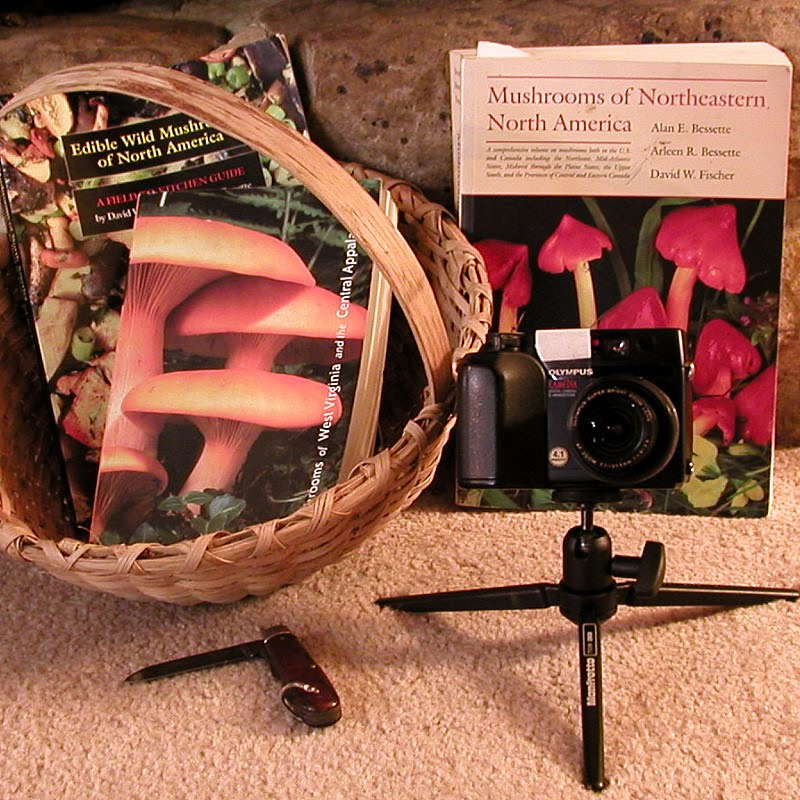
Tools of the Trade


The picture shows the tools I most frequently use when mushroom foraging. The knife and basket are essential. A knife cuts the mushroom free from the ground and prevents dirt from being collected and messing up your harvest. The basket is a nice device for carrying your harvest, and keeps your collection fresh. Additionally, spores may drop onto the ground through the basket weaving creating opportunities for future collecting. My basket was locally made using strips of White Oak.

The camera is a small Olympus digital with a decent f1.8 lens, able to catch a lot of light in the dark forest. You may notice the tissue paper taped over the flash. This helps to diffuse the light when taking close-ups while using the flash. The tripod is a small Manfrotto model 709B. Tripods are essential in low light conditions, plus they're indispensable when taking multiple exposures for use in high dynamic range photography.

The field guidebooks are regional guides to mushrooms commonly found in the area where I forage, or as a source of recipes and food preparation. The Internet can be useful for assisting in identification, and as a source for recipes.

Monday, November 23, 2009

Orange Mock Oyster


Orange Mock Oyster, Phyllotopsis nidulans, is pretty to look at, but that's about all it has going for it. Field guidebooks describe it as having a disagreeable odor and taste, but I couldn't distinguish any bad smell or taste. Nevertheless, it is considered to have no culinary value. The top is noticeably fuzzy. After drying the gills are a vivid orange.

Galerina autumnalis - Deadly Galerina


If one is serious about collecting mushrooms it is important to learn which species are harmful. And, since deadly mushrooms are the worst kind of harmful it is wise to be able to recognize them. The picture above is what I've always assumed to be Galerina autumnalis, the Deadly Galerina. It is small, grows on dead wood, and about the same color as freshly fallen oak leaves; a warm brown. Spore print is rusty brown.